
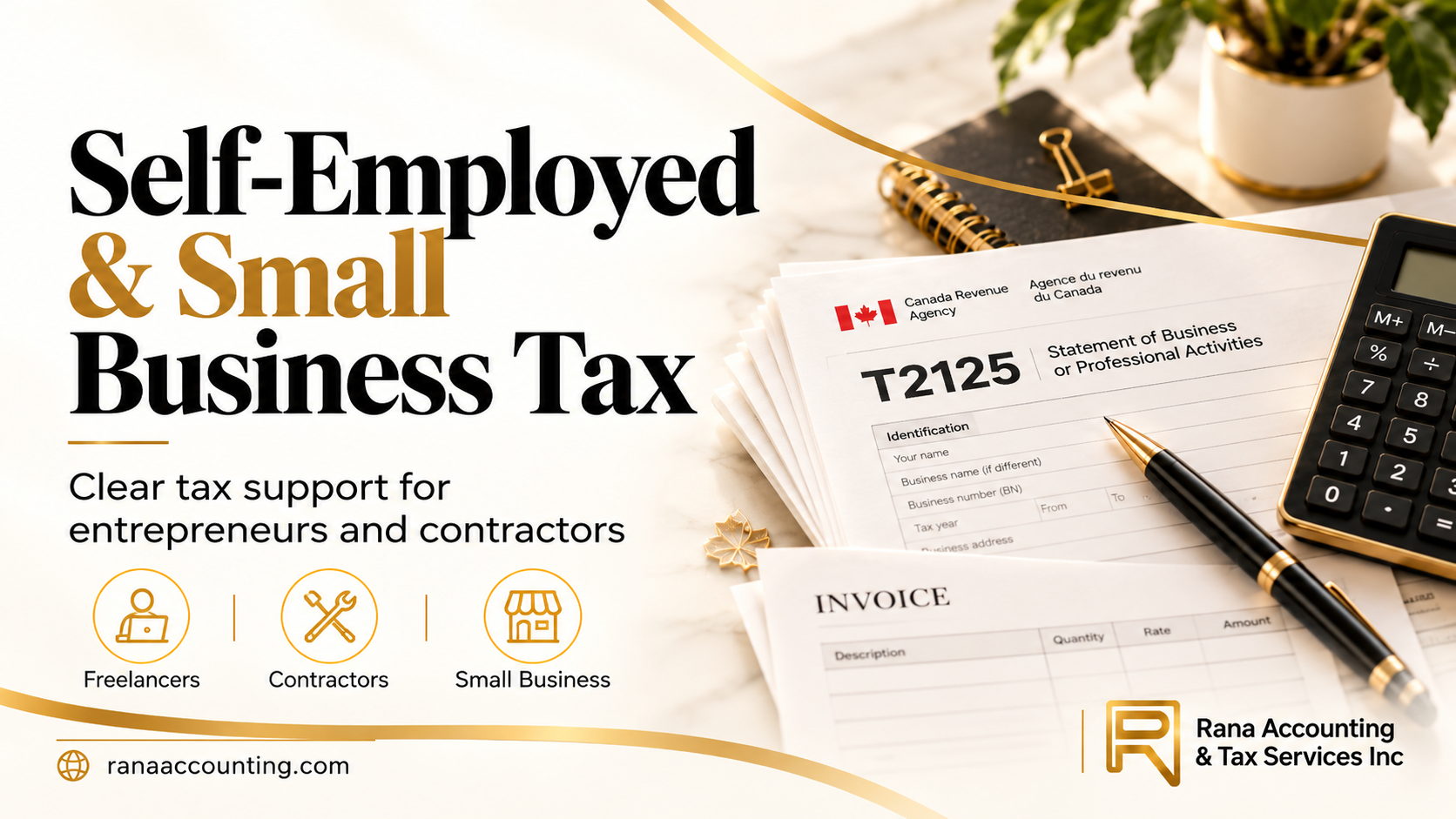
Self-Employed Tax Filing Winnipeg (2026) | Rana Accounting
Self-Employed Taxes in Canada (2026): Winnipeg Small Business Guide
self-employed-tax-filing-winnipeg-2026
Self-Employed Taxes in Canada (2026): Winnipeg Small Business Guide
Published: October 22, 2026 | Rana Accounting & Tax Services Inc.
Are you self-employed in Winnipeg, working as a freelancer, operating a small business, or earning income from a side hustle?
Understanding your Canadian tax obligations is important. From reporting business income on Form T2125 to tracking deductible expenses and determining whether you need to register for GST/HST, good recordkeeping can make tax filing much easier.
This guide explains the essential tax considerations for self-employed individuals and small-business owners in Canada.
1. Who Is Considered Self-Employed in Canada?
You may be self-employed if you earn income by working for yourself instead of receiving wages as an employee.
Common examples include:
- Freelancers and independent consultants
- Construction workers and subcontractors
- Uber and delivery drivers
- Online sellers and e-commerce businesses
- Cleaning and home-service businesses
- Independent IT professionals
- Sole proprietors and other small-business owners
Even if your business operates part-time or alongside a regular job, you generally must report the business income you earn.
Your classification depends on the actual working relationship, not simply whether someone calls you a contractor.
2. What Is CRA Form T2125?
Form T2125 Statement of Business or Professional Activities is used to report business or professional income and expenses as part of an individual's Canadian income tax return.
For example, a self-employed consultant in Winnipeg may use Form T2125 to report consulting revenue, eligible business expenses, and net business income.
Your net business income is generally calculated as:
Business Revenue − Allowable Business Expenses = Net Business Income
For example:
- Annual business revenue: $60,000
- Allowable business expenses: $14,000
- Net business income: $46,000
This is an illustrative calculation, not the final income tax owing. Other income, deductions, adjustments, and CPP contributions can affect the return.
Important: Incorporated businesses generally file a separate corporate income tax return (T2). Form T2125 is not a replacement for a corporation's T2 return.
3. What Business Expenses Can Self-Employed Canadians Claim?
One important part of self-employed tax preparation is identifying eligible business expenses.
Depending on your business and circumstances, deductible expenses may include:
Office Supplies and Business Software
Expenses for eligible office supplies, bookkeeping software, and subscriptions used to operate your business.
Advertising and Marketing
Business-related website expenses, advertising campaigns, and promotional costs.
Accounting and Professional Fees
Eligible accounting, bookkeeping, legal, and other professional costs incurred for business purposes.
Business Vehicle Expenses
The business-use portion of qualifying fuel, insurance, repairs, and other eligible vehicle expenses. Maintain a mileage log supporting business and total kilometres driven.
Home Office Expenses
A qualifying workspace may allow you to deduct a reasonable portion of eligible household expenses, subject to CRA conditions.
Telephone and Internet
The reasonable business-use portion of eligible telephone and internet expenses.
Not every purchase is immediately deductible. Capital assets may require different treatment, and personal expenses are generally not deductible as business expenses.
Keeping invoices and receipts is essential.
4. Do Self-Employed Businesses Need GST/HST Registration?
One of the most common questions from Canadian freelancers is:
“Do I need to register for GST/HST when my business earns more than $30,000?”
For most businesses, the CRA's small-supplier threshold is $30,000 in taxable supplies over a single calendar quarter or four consecutive calendar quarters, subject to the applicable rules.
Registration timing depends on how and when the threshold is exceeded.
For example, exceeding the threshold within a single calendar quarter can trigger an immediate obligation to charge GST/HST on the transaction that takes you over the threshold.
You should monitor revenue regularly rather than waiting until tax season.
GST/HST registration is also separate from personal income tax reporting. A business earning less than $30,000 may still have to report its income for income tax purposes.
Businesses in Manitoba may also have separate provincial Retail Sales Tax (RST) obligations, depending on their activities.
Need assistance? Explore our GST/HST Filing Services.
5. Do Self-Employed Individuals Pay CPP?
Generally, self-employed individuals are responsible for both the employee and employer portions of applicable Canada Pension Plan (CPP) contributions on their pensionable self-employment earnings.
CPP is calculated under the applicable rules when preparing the personal income tax return.
This is one reason your final balance owing may be different from what you expected based only on income tax.
Depending on your situation, income tax instalment payments may also be required during the year.
6. When Are Self-Employed Taxes Due?
Self-employed individuals generally have until June 15 to file their personal tax returns, subject to the applicable CRA rules and exceptions.
However, any income tax balance owing is generally due April 30, not June 15.
For example, the CRA's published deadlines for 2025 tax returns were:
- April 30, 2026 — Income tax payment deadline
- June 15, 2026 — Self-employed filing deadline for eligible taxpayers
If you are preparing for the 2026 tax year, check the CRA's applicable 2027 deadlines and any exceptions.
GST/HST returns have their own filing and payment deadlines based on the reporting period and circumstances.
7. What Records Should Small-Business Owners Keep?
Good bookkeeping can reduce mistakes and make tax preparation more efficient.
Consider maintaining these records throughout the year:
- Sales invoices and income records
- Business expense receipts
- Business bank and credit card statements
- Vehicle mileage logs, where applicable
- Business-related contracts
- GST/HST records
- Payroll records, if you have employees
- Previous tax returns and CRA notices
The CRA generally requires business records to be retained for at least six years from the end of the last tax year to which they relate, although exceptions exist.
Need help organizing your books? Visit our Bookkeeping Services in Winnipeg.
8. Common Self-Employed Tax Mistakes to Avoid
Small-business owners should watch for these common mistakes:
- Not reporting side-hustle income. Small amounts of business income can still be reportable.
- Mixing personal and business expenses. This makes recordkeeping and expense claims more difficult.
- Failing to track GST/HST registration thresholds. Late registration can create additional tax obligations.
- Claiming personal purchases as business deductions. Only eligible business-related amounts should be claimed.
- Missing tax deadlines. Filing deadlines and payment deadlines are not always the same.
Maintaining proper financial records throughout the year is usually easier than organizing everything just before filing.
Frequently Asked Questions
Do freelancers in Winnipeg need to file taxes?
Freelancers generally must report taxable business income on their personal income tax returns, even if the work is part-time or a side hustle.
Can I claim business expenses if I work from home?
Potentially. If you satisfy the CRA's business-use-of-home requirements, you may claim an eligible portion of qualifying expenses.
Do I need to register for GST/HST if I earn less than $30,000?
Most businesses below the applicable small-supplier threshold are not required to register, although voluntary registration may be available. Special rules and exceptions can apply.
What is the difference between T1 and T2 tax filing?
A T1 is a personal income tax return that can include self-employment income reported on Form T2125. A T2 is a separate income tax return for corporations.
Need Help With Self-Employed Tax Filing in Winnipeg?
At Rana Accounting & Tax Services Inc., we assist freelancers, contractors, sole proprietors, and small-business owners with:
- Self-employed personal tax returns (T1/T2125)
- Corporate tax filing (T2)
- Business bookkeeping and reconciliations
- GST/HST and Manitoba RST/PST filing assistance
- Payroll and year-end reporting
- Business registration assistance
We provide in-person appointments in Winnipeg, Manitoba, and online services across Canada, excluding Quebec.
Your Taxes. Your Business. Our Priority.
Contact: Rana Accounting & Tax Services Inc.
Rana Accounting & Tax Services Inc.
Rana Sma
Phone: 204-295-6695
Labib Rana
WhatsApp: 431-374-6695
Email: ranaaccountingtax@outlook.com
Website: https://www.ranaaccounting.com/
Explore Our Personal Tax Filing Services
Official CRA Resources
This article provides general Canadian tax information as of October 22, 2026. Tax treatment depends on individual circumstances. Consult the CRA or a qualified tax professional before making filing decisions.